
System description and function
The Fischer Panda VS-Series »Variable-Speed-Hybrid-DC-Generators« have been especially designed for maritime battery-charging and hybrid electric propulsion on board. The VS-DC-Generator-System generates DC voltages that are available at the HV outputs (High Voltage) from the VS-DC-Generator System.
The VS-Generator-System usually consists of different components. First, the diesel engine that converts mechanical energy from diesel fuel. The engine shaft of the diesel-engine is mechanically connected to an electric permanent-magnet-synchronous-machine (PMSM). The PMSM generates three phase AC-Voltages which frequency and amplitude dependent on the motor speed of the diesel engine.
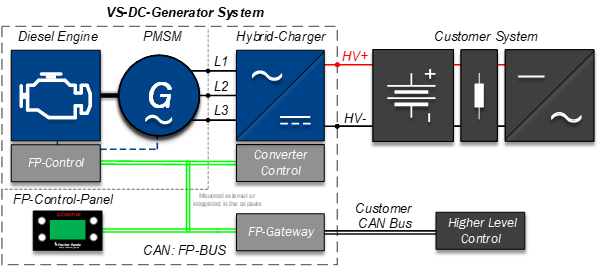
The variable AC-voltage is converted into constant DC-voltage available at the HV-DC-Outputs of the VS-DC-Generator. The HV-DC-Voltages are decoupled from the mechanical motor-speed dependent frequency and amplitude of the PMSM by the Hybrid-Charger-Power-Electronic. The Hybrid-Charger is an active boost rectifier topology device. It is possible to provide a high voltage even at low motor speeds using this power electronic.
The HV-DC-Outputs of Hybrid-Charger are also the outputs of the VS-DC-Generator. This HV-DC Outputs can connect directly to a high voltage battery or be integrated in a customer HV-DC-Bus.
The components of the VS-DC-Generator are interconnected by the CAN-SAE-J1939 based FP-Bus. The FP-Bus connects the FP-Control which controls the diesel engine, the Converter-Control which controls the Hybrid-Charger, the FP-Control-Panel (HMI) and the FP-Gateway for integration into higher level control systems.
The FP-Control is the main control component in the VS-DC-Generator. When the system goes into sleep mode, the FP-Control powers down all components, then system only requires a few µA standby current from the starter battery. A wake-up signal allows the system to be started from the FP-Control-Panel or a higher-level control-system.
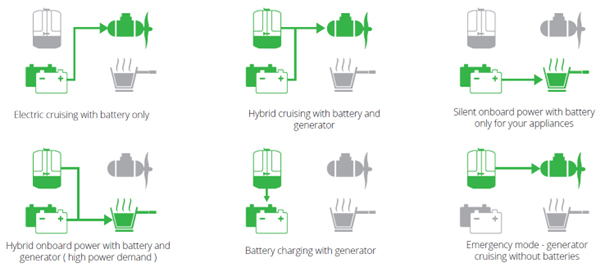
The Fischer Panda VS-DC-Generators are designed for operation in hybrid-electric propulsion systems or dc-on-board power systems which are primarily supplied by a battery bank. If additional energy for battery charging or electric propulsion is required, the VS-Generator-System is switched to the existing battery or DC-system. Possible situations for integration of the VS-DC-Generator are illustrated in figure 2.
 |
| Note: A special case is the last illustrated situation in figure 2 when no battery or DC-system are present. This mode of operation was mainly intended for emergency situations. If this mode of operation is intended, the entire system must be designed for this case in order to meet all technical and normative requirements. Possibly additional components must also be installed into the customer system such as additional electric energy-storages, break-choppers, precharge-resistors, and an insulation monitoring device. The dynamic of VS-DC-Generator must be adjusted to the dynamic of the DC-system and the propulsion system. A configuration for pre-charging empty DC-link-capacitors or switching to passive loads may be required. |
The VS-DC-Generator has a default configuration for presets because the customer system specific parameter like dc-operating-voltage, battery-capacity, propulsion system, passive loads, or cable diameters are not known during the manufacture process. The VS-DC-Generator can be configured manually using the FP-Control-Panel or from a higher-level control-system by CAN-Bus.